We Use CookiesWe use cookies to enhance the security, performance, functionality and for analytical and promotional activities. By continuing to browse this site you are agreeing to our privacy policy

10 Best Dj Amplifiers 2025 in the United States

How do we rank products for you?

Our technology thoroughly searches through the online shopping world, reviewing hundreds of sites. We then process and analyze this information, updating in real-time to bring you the latest top-rated products. This way, you always get the best and most current options available.

headphones-stars

Our Top Picks

#1

Winner

Yamaha PX3 Dual Channel 2x500W Lightweight Power Amplifier w/ DSP

Rating
10.0
Chosen by1,270
Power Output

Most important from
65 reviews

Power Output
Its power output is sufficient to deliver clear, distortion-free sound suitable for both DJ setups and home theater systems.

The Yamaha PX3 is a solid choice for DJs needing a reliable and fairly powerful amplifier. It delivers 2 x 500 watts at 4 ohms, which is sufficient for most small to medium DJ setups, providing clear and strong sound without distortion. The amplifier is notably lightweight—about 50% lighter than previous Yamaha models—making it easier to transport to gigs. It includes useful onboard features like digital signal processing (DSP) and Yamaha's D-Contour for better sound shaping, which helps maintain audio quality even at higher volumes.

The unit also offers convenient tools such as a configuration wizard and panel lock to prevent accidental changes, along with event logging, which can be helpful for troubleshooting. In terms of build, it uses metal and plastic to balance durability and weight. The product dimensions are somewhat bulky for its power class, so users should consider the size when planning their setup. The amplifier has a respectable signal-to-noise ratio and keeps distortion low, ensuring clean sound output.

This amplifier suits DJs who want a dependable, easy-to-handle power amp with good sound-shaping features, especially if portability is important. Those needing very high power or advanced connectivity might want to explore other models.

Rating
10.0
Chosen by1,270
Power Output

Most important from
65 reviews

Power Output
Its power output is sufficient to deliver clear, distortion-free sound suitable for both DJ setups and home theater systems.
#2

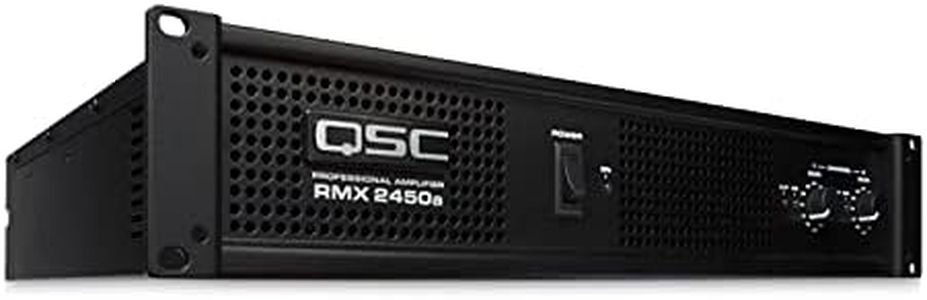
QSC RMX2450a 800 Watt 2 Channel Power Amplifier

Rating
8.8
Power Output
Inputs and Outputs

Most important from
53 reviews

Power Output
This is the best balance of quality sound and power for the price. Strong, powerful, but clear.
Inputs and Outputs
Works great and love the sound. Easy to install.

The QSC RMX2450a is a solid choice for DJs and audio professionals looking for a reliable power amplifier that delivers professional quality performance. With a power output of 800 watts across two channels, it provides strong audio support for various events, making it suitable for both small gigs and larger venues. Its high-current toroidal transformers enhance its performance at lower impedances, specifically 2 ohms, which is a definite plus for those who need extra power without compromising on sound quality. The independent clip limiters help in reducing distortion, ensuring that your sound remains clean even at higher volumes, which is crucial during live performances.

One standout feature is the selectable low-frequency filters at 30 Hz and 50 Hz, which help protect your speakers and improve sound clarity. This functionality is especially valuable for DJs who want to avoid damaging their equipment while still delivering a powerful bass response.

However, this amplifier isn't without its drawbacks. Its size (28 x 6 x 24 inches) can be cumbersome for mobile setups, and it may be less appealing for those with limited space. Additionally, while it includes various inputs like balanced 1/4 inch TRS and XLR, it lacks modern connectivity options like Bluetooth or USB, which could be a downside for some users looking for convenience. In terms of cooling, it’s designed to handle heavy use, but the cooling system specifics aren't detailed. Lastly, while the THD and SNR values are not explicitly stated in the specs, these factors are crucial for sound clarity and performance, and potential buyers may want to look for that information before making a decision. The QSC RMX2450a is a great option for dedicated DJs and audio professionals who prioritize sound quality and performance, but those needing portability or advanced connectivity might want to explore other options.

Rating
8.8
Power Output
Inputs and Outputs

Most important from
53 reviews

Power Output
This is the best balance of quality sound and power for the price. Strong, powerful, but clear.
Inputs and Outputs
Works great and love the sound. Easy to install.
#3

Rockville RPA16 10000W Peak/3000W RMS 2-Channel Power Amplifier, Bridgeable, Built-in Crossover, Limiter, LCD Display, XLR/Speakon/Banana Outputs, for Pro Audio and DJ

Rating
8.2
Power Output
Inputs and Outputs

Most important from
283 reviews

Power Output
Delivers impressive power output that easily drives large speaker setups without issues over extended use.
Inputs and Outputs
Works seamlessly with professional gear, allowing simple RCA to XLR connections with no buzzing or signal problems.

The Rockville RPA16 is a powerful 2-channel amplifier well-suited for DJs and live sound use, offering up to 1500 watts RMS per channel at 4 ohms and 3000 watts bridged into one channel for subwoofers. This makes it capable of driving large speaker setups with plenty of headroom. It supports 4 and 8 ohm speakers, providing flexibility depending on your speaker system. The amp maintains low distortion (less than 0.04% THD) and a high signal-to-noise ratio (over 100dB), which means your sound stays clear and free from unwanted noise during performances. Its built-in limiter and clipping indicators help protect your speakers from damage, a valuable feature for DJs who push volume levels.

The cooling system uses quiet, high-velocity fans, which effectively manage heat without adding distracting noise. Inputs are balanced with a high impedance for compatibility with professional audio gear, and the amplifier offers versatile modes (stereo, bridged, parallel) and crossover settings that help tailor output for different speaker arrangements. It also includes helpful front-panel displays showing volume and temperature, plus a rugged rack-mount design for easy integration into pro setups.

At around 41 pounds, it is a bit heavy and may not be ideal for quick, frequent transport. The size and power make it best suited for stationary or semi-permanent DJ rigs rather than portable use. The RPA16 provides strong power, solid sound quality, and useful protective features, making it a reliable choice for DJs needing a robust amplifier for club or event sound systems.

Rating
8.2
Power Output
Inputs and Outputs

Most important from
283 reviews

Power Output
Delivers impressive power output that easily drives large speaker setups without issues over extended use.
Inputs and Outputs
Works seamlessly with professional gear, allowing simple RCA to XLR connections with no buzzing or signal problems.

Buying Guide for the Best Dj Amplifiers

Choosing the right DJ amplifier is crucial for ensuring that your sound system delivers the best possible performance. An amplifier boosts the audio signal from your DJ mixer or controller to drive your speakers effectively. When selecting an amplifier, it's important to consider several key specifications to ensure it meets your needs and provides the best sound quality for your setup. Here are the key specs you should focus on and how to navigate them.
Power OutputPower output, measured in watts, indicates how much power the amplifier can deliver to your speakers. This spec is important because it determines the volume and clarity of the sound. Amplifiers with higher wattage can drive larger speakers and produce louder sound without distortion. For small venues or home use, an amplifier with 100-300 watts per channel may suffice. For larger venues or outdoor events, you might need 500 watts per channel or more. Consider the size of your venue and the type of events you will be hosting to determine the right power output for you.
ImpedanceImpedance, measured in ohms, refers to the resistance the amplifier will face from the speakers. This spec is important because matching the amplifier's impedance with your speakers ensures optimal performance and prevents damage to your equipment. Common impedance values are 4, 8, and 16 ohms. Most DJ amplifiers are designed to work with 8-ohm speakers, but some can handle 4-ohm loads for more power. Check your speaker's impedance and choose an amplifier that matches or supports it.
Total Harmonic Distortion (THD)Total Harmonic Distortion (THD) measures the amount of distortion the amplifier introduces to the audio signal, expressed as a percentage. This spec is important because lower THD means cleaner and more accurate sound reproduction. A THD of less than 1% is generally acceptable for most applications, but for high-fidelity sound, look for amplifiers with THD below 0.1%. If sound quality is a top priority for you, aim for the lowest THD possible.
Signal-to-Noise Ratio (SNR)Signal-to-Noise Ratio (SNR) measures the level of the desired audio signal compared to the level of background noise, expressed in decibels (dB). This spec is important because a higher SNR means clearer sound with less background noise. An SNR of 80 dB or higher is considered good for most DJ applications. If you are performing in a quiet environment or require high audio fidelity, look for an amplifier with an SNR of 100 dB or higher.
Cooling SystemThe cooling system in an amplifier helps prevent overheating during extended use. This spec is important because overheating can lead to performance issues or damage to the amplifier. Amplifiers typically use either passive cooling (heat sinks) or active cooling (fans). Passive cooling is quieter but may not be as effective for high-power amplifiers. Active cooling is more efficient but can produce fan noise. Consider the environment in which you'll be using the amplifier and choose a cooling system that balances performance and noise levels.
Inputs and OutputsThe inputs and outputs on an amplifier determine how you can connect it to your other equipment. This spec is important because it affects compatibility with your DJ mixer, controller, and speakers. Common input types include XLR, RCA, and 1/4-inch jacks, while outputs are typically binding posts or Speakon connectors. Ensure the amplifier has the necessary inputs and outputs to match your existing gear. If you plan to expand your setup in the future, look for an amplifier with versatile connectivity options.

FAQ